
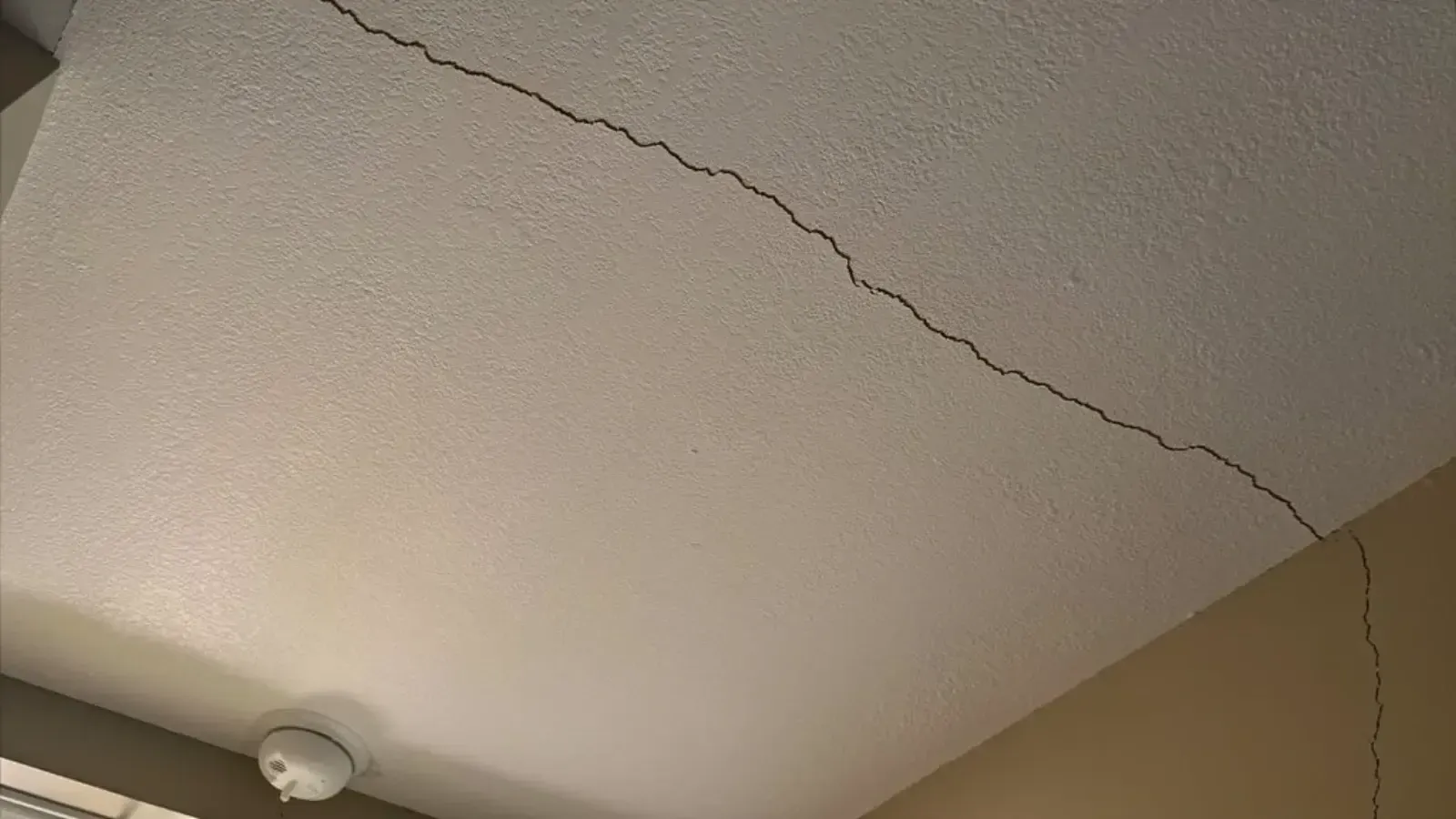
Signs you need this
- • A hairline crack running along the ceiling perimeter or straight across a room, present for months with no leak behind it.
- • A ceiling that feels a little lower or springy underfoot from above, with no staining or discoloration.
- • An older plaster ceiling shedding fine white dust or feeling soft when pressed, not from water but from age.
- • Repeating cracks at the same drywall seams, especially where a partition wall meets the ceiling.
Providence Premier Drywall diagnoses why a ceiling is cracking, sagging, or shedding when there is no water involved, then fixes the actual cause rather than just filling the crack. That might mean refastening loose board, stabilizing failing plaster keys, or replacing a section that has let go, followed by a finish that matches the rest of the ceiling.
Cracking and sagging without a leak
Not every ceiling problem in Providence starts with water. A ceiling can crack, sag, or shed fine dust for reasons that have nothing to do with a leak: a plaster key letting go, a fastener working loose over years of seasonal movement, or a seam that flexes a little every winter and shows it in the paint. We check for moisture first, because ruling it out is the fastest way to point the repair in the right direction, then we look at what is actually failing above the surface. A hairline crack that traces the same line every year is telling you something different than a ceiling that feels soft when you press on it, and the repair has to match the cause, not just the symptom.
Why Providence’s older ceilings crack and shed
College Hill and the East Side carry a large share of the city’s pre-1940 housing stock, much of it still finished in lime plaster over wood lath. That system relies on plaster keys, the small fingers of material that squeeze through the lath gaps and lock the ceiling in place. Over eight or nine decades those keys dry out and crumble, and a ceiling that looks intact can be losing its grip an inch at a time. In the triple-decker belt around Elmhurst, near Providence College, drywall ceilings move for a different reason: seasonal framing shift opens the same seam every winter as the wood dries and swells. Both patterns produce a crack that a homeowner has usually already tried to spackle once, only to watch it come back.
Diagnosing before we touch anything
We probe the plaster for soft or hollow spots, check the fastener pattern on a drywall ceiling, and look at where the crack sits relative to partition walls and framing below. A crack that runs parallel to a wall below it often points to truss uplift or seam movement at that wall. A soft, springy area points to plaster keys that have already failed. Getting this right before we open anything up is what separates a repair that lasts from one you’re calling back about next season, because refastening a loose ceiling and skim-coating a failed plaster section are two different jobs even though they can look similar from below.
Finishing so the ceiling reads as one surface
Once the cause is addressed, the finish work is what makes the repair disappear. We tape and coat to a Level 4 finish for most ceilings, and step up to Level 5 on ceilings that catch strong raking light, where anything less shows every seam. We match the existing texture, whether that’s a knockdown pattern common in Providence’s mid-century units or a smooth trowel finish in an older plaster room, and on ceilings old enough to carry popcorn texture, we test for asbestos before removing anything. A ceiling repair that’s diagnosed correctly and finished to the right level shouldn’t be visible once the room is painted, and shouldn’t need a second visit next winter.
Materials & standards
Products & materials we use
- Structo-Lite basecoat plaster
- Plaster washers
- USG and CertainTeed joint compound
- FibaTape mesh tape
Standards & codes we work to
- ASTM C840
- GA-216
- GA-214 finish Levels 4 and 5
What the terms mean
- Plaster keys
- Skim coat
- Knockdown and orange-peel texture match
- Level 5 finish
- Raking light
- Popcorn ceiling
- Asbestos testing
Options & variants
| Option | When it applies | Cost |
|---|---|---|
| Hairline crack repair with reinforcement | Isolated, non-recurring cosmetic crack | Lowest scope |
| Plaster key stabilization or partial patch | Older plaster ceiling with localized key failure | Moderate |
| Sagging ceiling correction (refasten, skim, or replace) | Visible sag or soft spot from fastener or key failure | Larger scope |
What affects cost
- • Plaster ceiling versus drywall ceiling, since plaster diagnosis and key inspection take more time than a drywall fastener check.
- • Height and access, including stairwells and cathedral or vaulted ceilings.
- • Whether the cause is structural movement, a seam or a header, versus a purely cosmetic surface issue.
- • Whether the whole ceiling needs a full recoat to Level 5 so the repair doesn't show under raking light.
- • Popcorn texture removal, which requires an asbestos-age check before anything is disturbed on older ceilings.
What to expect
- 1
Describe the crack or sag
You tell us where it is, how long it's been there, and whether it's changing.
- 2
On-site inspection
We probe plaster keys or check the drywall fastener pattern, and rule out any water source before going further.
- 3
Identify the cause
We determine whether it's a fastener pop, plaster key failure, seasonal seam movement, or a soft section that needs to come out.
- 4
Address the cause
We refasten, add plaster washers, skim-coat, or cut and patch, depending on what's actually failing.
- 5
Tape and finish
We tape and coat to a Level 4 or Level 5 finish depending on the ceiling and light in the room, and match the existing texture.
- 6
Clean up and walk-through
We clean up and walk the finished ceiling with you, and tell you honestly if the underlying movement is likely to show up again seasonally.
When this isn’t the right call
- If there's a stain, brown ring, or any sign of a leak, water damage drywall repair is the better fit.
- If an entire plaster ceiling is failing broadly, not just a local spot, plaster repair and conversion is the better fit.
- If it's just a couple of small nail pops on a wall, not the ceiling, drywall repair and patching is the better fit.
Frequently asked questions
Why is my ceiling cracking if there's no leak? +
Ceilings crack for reasons that have nothing to do with water. Seasonal movement at a seam, a fastener working loose, or old plaster keys losing their grip on the lath can all produce a crack. We check for water first, then look at what's actually moving.
Is a sagging ceiling dangerous? +
A soft or visibly sagging spot means something is failing, whether that's plaster keys or drywall fasteners, and it's worth having looked at before it gets worse. We check the extent of it and tell you honestly whether it's cosmetic or needs structural attention.
My plaster ceiling sheds white dust but there's no visible damage. What's happening? +
That's often plaster losing its bond to the lath behind it, which is common in Providence's pre-1940 housing stock. We can stabilize the affected area or, if it's widespread, talk through a fuller plaster repair.
Will the repaired area match the rest of the ceiling? +
That's the goal. We match the existing texture and, on a ceiling where a patch would show under raking light, we often recoat the whole surface to a Level 5 finish so it reads as one uniform ceiling.
Can you tell if a crack will come back? +
Often, yes. If the crack traces a seasonal seam or a known movement point in the framing, we'll tell you that up front rather than promise a permanent fix on a spot that's likely to move again.
Do you remove popcorn ceilings? +
Yes, and on any ceiling old enough to be a candidate for asbestos, we test before removing texture, not after.