
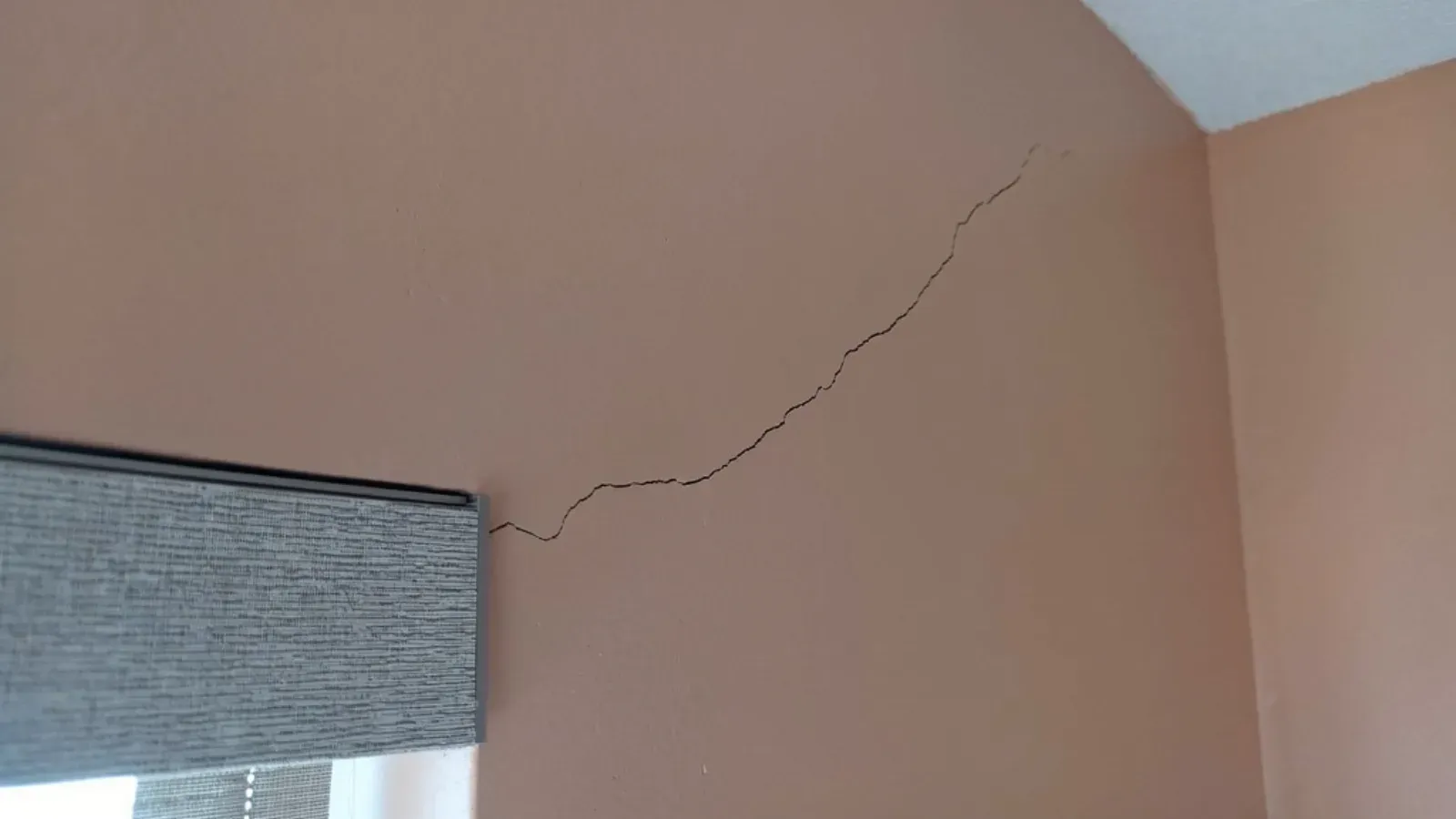
Signs you need this
- • The same crack over a doorway or window opening that returns every year, no matter how many times it's been spackled.
- • A crack running diagonally from a corner, or straight down a wall along a stud line.
- • Cracking right where a metal corner bead meets the wall, with the corner chipping or splitting along that line.
- • A crack that widens in winter and seems to close up a little by summer.
Providence Premier Drywall diagnoses why a crack keeps coming back before repairing it. That means finding whether the movement is coming from a header, a stud line, seasonal shift, or a failed corner bead, and choosing the right reinforcement for that cause, mesh tape, paper tape, or new bead, instead of just filling the visible line and hoping it holds.
A crack that keeps coming back is a diagnosis problem
Filling a crack is easy. Keeping it from reopening is the actual job. Most homeowners who call about a crack have already patched it once, sometimes twice, and watched it return on the exact same line months later. That pattern is the clue: a crack that reopens in the same place is being driven by something behind the wall, movement at a header, a stud drying and shrinking, a corner bead that’s lost its grip, and no amount of joint compound fixes that on its own. Before we tape anything, we trace the crack’s path and check what’s moving behind it, because the reinforcement that stops a header crack isn’t the same one that stops a corner bead from splitting again.
Why Providence’s older stock moves seasonally
Fox Point and Federal Hill sit on some of the city’s oldest building stock, much of it on foundations that shift slightly with the freeze-thaw cycle every New England winter. That small seasonal movement transmits up into the framing and shows as a crack that opens in January and seems to close a little by August, then repeats the next year. In the triple-decker belt, the pattern is different but related: framing settles and dries under normal use, and cracks tend to follow stud lines or run diagonally from door and window corners, the natural stress points in any wood-framed structure. Neither pattern usually means something is wrong with the house. It means the repair has to be built to handle ongoing movement instead of pretending the wall will hold perfectly still.
Mesh vs paper tape, and when the corner bead is the real problem
Paper tape sets into a thin bed of compound and creates a very flat, clean line, ideal where a crack has genuinely settled and isn’t expected to keep moving. Mesh tape has a little more flexibility built in and holds up better on a crack that’s likely to see some continued seasonal movement. Corner bead is its own category of failure: a bead that’s dented, bowed, or split at a seam will crack again at that exact spot no matter how it’s coated, because the metal itself is compromised. We replace bead rather than repeatedly patch around a corner that’s going to keep failing.
Coating a crack so it doesn’t telegraph
Once the right reinforcement is chosen, the finish work is what keeps the repair invisible. We coat in several thin passes, feathering each one wider than the last so the edge of the repair blends smoothly into the surrounding wall rather than showing as a ridge or a faint shadow under angled light. On a wall where the crack ran a long distance, that sometimes means recoating more of the surface than just the crack itself, so the whole plane reads flat and consistent once it’s painted.
Materials & standards
Products & materials we use
- FibaTape mesh tape
- Paper tape
- Corner bead
- USG and CertainTeed setting-type joint compound
Standards & codes we work to
- ASTM C840
- GA-216
What the terms mean
- Control joint
- Corner bead
- Mesh versus paper tape
- Header deflection
- Feathering
- Seasonal movement
Options & variants
| Option | When it applies | Cost |
|---|---|---|
| Re-tape with mesh reinforcement | Isolated, non-recurring crack | Lowest scope |
| Corner bead replacement | Bead itself is cracked, dented, or split | Moderate |
| Flexible repair for a known seasonal crack | Crack has recurred and traces ongoing seasonal movement | Moderate to higher, engineered to move with the house |
What affects cost
- • Whether the crack is new or has already recurred, since a recurring crack needs root-cause work, not just a fill.
- • Mesh tape versus paper tape versus a more flexible reinforcement approach, chosen for how the specific crack behaves.
- • Corner bead condition, whether it can be reused or needs to be replaced.
- • Location: over a door or window header, along a stud line, or at a corner, each calling for slightly different handling.
- • Whether the surrounding wall needs a wider recoat so the repair line doesn't telegraph through paint.
What to expect
- 1
Describe the crack
You tell us where it is, how long it's been there, and whether it's returned after a prior patch.
- 2
On-site inspection
We inspect the crack's path and check the framing and corner bead condition behind it.
- 3
Diagnose the cause
We determine whether it's seasonal movement, header deflection, stud shrinkage, or a failed bead.
- 4
Choose the reinforcement
We pick mesh tape for flexibility, paper tape for a clean flat line, or new corner bead where it's damaged.
- 5
Tape and coat
We tape and coat in several thin, wide-feathered layers so the repair doesn't show as a ridge or a shadow line.
- 6
Sand, texture, and prime
We sand, texture match, and prime, then explain honestly whether the underlying movement is likely to recur.
When this isn’t the right call
- If the crack is on the ceiling and tied to plaster key failure or sag, ceiling repair is the better fit.
- If it's a single small hole or ding, not a crack, drywall repair and patching is the better fit.
- If the crack followed a leak or water event, water damage drywall repair is the better fit.
- If an entire wall of old plaster is failing broadly, plaster repair and conversion is the better fit.
Frequently asked questions
Why does this crack keep coming back after I've filled it myself? +
A basic fill covers the crack but doesn't address what's causing it to open in the first place. If the movement behind it is seasonal or tied to the framing, a simple compound fill will crack again on the same line. We diagnose the cause first, then choose reinforcement built to handle that movement.
Is a diagonal crack from a corner a structural problem? +
Not usually. Diagonal cracks from window and door corners are one of the most common patterns in older homes and are typically normal stress concentration, not a structural issue. We look at the specific pattern to confirm before treating it as routine.
What's the difference between mesh tape and paper tape for a crack? +
Mesh tape has some give and works well where a little ongoing movement is expected. Paper tape creates a flatter, cleaner line and holds up better where the crack is truly settled and not likely to move again. We pick based on what's actually happening behind the wall.
Will you replace the metal corner bead or just patch around it? +
If the bead itself is dented, split, or pulling away, we replace it. Patching over a damaged bead just gives the crack a new place to reopen.
Do winter cracks in New England ever fully stop? +
Some seasonal movement is normal in older houses and never fully disappears, but the right reinforcement can keep the crack from reopening at the surface even if the framing behind it still shifts slightly each season.
Can a recurring crack mean a foundation problem? +
Occasionally, if the pattern is severe or paired with sticking doors and windows. Most recurring cracks in Providence's older stock are normal seasonal or settling movement, but we'll say plainly if what we see points to something worth a structural opinion.