
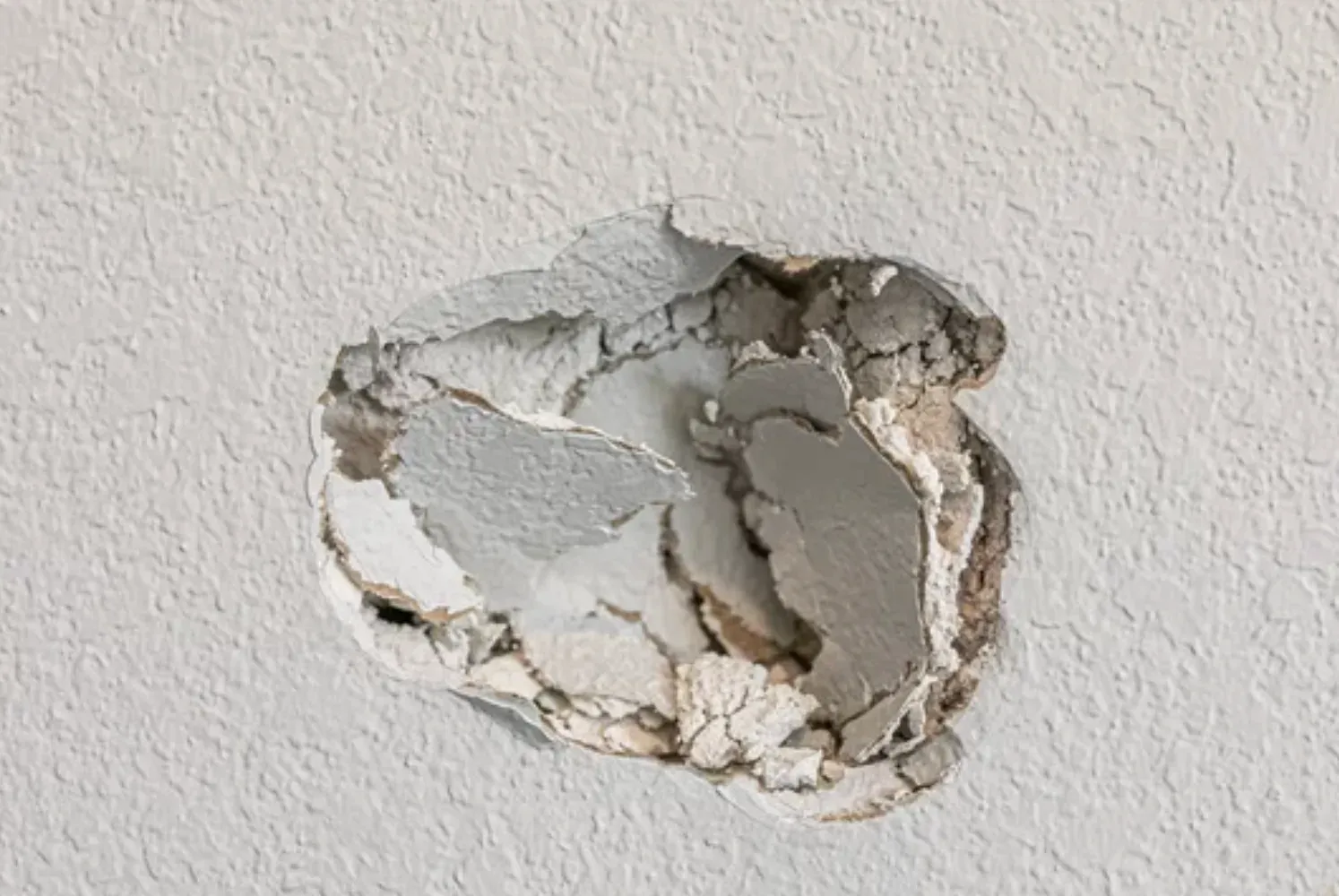
Signs you need this
- • A doorknob-sized hole punched through a bedroom or hallway wall.
- • A cluster of nail pops or screw dimples along a wall, each one cracking the paint around it.
- • Small holes left behind from a picture hook, a shelf anchor, or a TV mounting bracket.
- • A tape seam that's blistering, or a corner bead that's dinged enough to show bare metal.
Providence Premier Drywall patches holes, dings, popped fasteners, and damaged corners quickly and cleanly. We cut back or fill the damaged spot, tape and coat it, and blend the texture so the repair disappears once it’s painted. Most jobs are fast, in-and-out work, and we can often turn around several units for the same landlord in one visit.
Small damage, fast turnaround
Most drywall repair calls in Providence aren’t emergencies, they’re deadlines. A landlord needs a unit ready for the next tenant, a homeowner wants a wall smooth before the painter shows up, a family wants a doorknob hole gone before guests arrive. Providence Premier Drywall treats these jobs as what they are: fast, precise patch work that shouldn’t take days or leave a visible mark. A hole from a doorknob or a moved dresser, a scatter of nail pops along a hallway, a chewed-up corner bead near a stairway, these are common, fixable problems, and the goal on every one is the same: get in, patch it right, and get out without disrupting the rest of the room.
Why Providence’s rental stock needs this so often
The city’s dense triple-decker belt across the West End, Elmwood, and Olneyville turns over tenants constantly, and every turnover leaves behind the same short list: a few holes, some popped fasteners, a dinged corner or two. For a small landlord or property manager running several units, patching them one at a time between move-outs adds up fast, and delaying it holds up the next lease. We scope multi-unit patch work the same way a GC scopes a punch list, count the spots, match the texture across units if it varies, and move through efficiently so a building doesn’t sit half-turned-over waiting on drywall.
Matching the patch to the wall
The difference between a patch that disappears and one that’s visible for years usually isn’t the hole itself, it’s the texture around it. Providence’s housing stock runs the full range, smooth plaster-era walls on the East Side, orange peel and knockdown texture in mid-century and newer units, and a patch that’s coated flat on a textured wall stands out under any decent light. We match the existing texture before priming, feathering the joint compound wide enough that the transition from old surface to new isn’t a hard edge.
When a nail pop means something more
A single popped fastener or a small crack next to a patched hole is normal wear, and a straightforward fix. But if the same spot keeps reopening after it’s been patched, that’s usually a sign of ongoing movement in the framing behind it, not a patching problem. We’ll tell you honestly when a repair is a quick fix versus when it’s part of a recurring crack that needs a different approach, rather than patch over a symptom that’s going to come back.
Materials & standards
Products & materials we use
- FibaTape mesh tape
- Self-adhesive patch material
- USG and CertainTeed joint compound
- Corner bead
Standards & codes we work to
- ASTM C840
- GA-214 finish Level 4
What the terms mean
- California patch
- Feathering
- Knockdown texture
- Orange peel texture
- Nail pop
- Screw pop
Options & variants
| Option | When it applies | Cost |
|---|---|---|
| Small hole patch (mesh or California patch) | Doorknob dings, anchor holes | Lowest scope |
| Multi-spot patch (nail pops, several small dings) | Turnover units, general wear | Low to moderate, scales with count |
| Larger cut-in patch (backer plus new piece) | Hole larger than a few inches | Moderate |
What affects cost
- • Number and size of the holes, from a single ding to a wall full of nail pops.
- • Whether the wall is textured and needs matching, orange peel, knockdown, or smooth, so the patch doesn't stand out.
- • Access, including whether furniture or wall hangings need to move first.
- • Turnover volume, since patching several units for one landlord in a single visit is more efficient than one-off calls.
- • Whether painting is bundled in or left to someone else.
What to expect
- 1
Describe the damage
You describe the holes or dings, and a photo is often enough for us to scope a small job before we arrive.
- 2
Quick look or photo scope
We take a quick look on site, or work from your photos for straightforward patches.
- 3
Cut back and set a backer
We cut back any damaged edges and set a backer behind larger holes so the patch has something solid to hold to.
- 4
Tape and coat
We tape and coat in thin layers, feathering the edges so the patch blends into the surrounding wall.
- 5
Sand and texture match
We sand and match the existing texture, whether that's smooth, orange peel, or knockdown.
- 6
Prime or paint
We prime the area so it's paint-ready, or paint it ourselves if that's part of the job.
When this isn’t the right call
- If a crack keeps coming back after being patched, tracing a seam or framing movement, drywall crack repair is the better fit.
- If the damage came from a leak or standing water, water damage drywall repair is the better fit.
- If it's the ceiling that's cracked or sagging, not a wall, ceiling repair is the better fit.
- If an entire wall's plaster is failing, not just a small spot, plaster repair and conversion is the better fit.
Frequently asked questions
How fast can you patch a hole before my open house or inspection? +
Small patches are often same-day or next-day work. Send a photo and a sense of the deadline and we'll tell you what's realistic.
Will the patch be invisible after painting? +
That's the goal. We feather the coats wide and match the surrounding texture before priming, so once it's painted the wall reads as one smooth surface, not a patchwork.
Do you patch multiple units at once for landlords? +
Yes, and it's more efficient for everyone. If you've got several units to turn over, tell us the scope up front and we'll schedule them together.
What's a California patch, and do I need a whole sheet replaced? +
A California patch is a self-supporting repair for small to medium holes that doesn't require cutting back to a stud. Most doorknob-sized holes and anchor holes fall into that category; full sheet replacement is rarely necessary for this kind of damage.
Can you match textured walls, like knockdown or orange peel? +
Yes. Matching the existing texture is part of the job, not an add-on, because a smooth patch on a textured wall is the most common way a repair ends up visible.
Do a lot of nail pops mean something's wrong with the house? +
Usually not. Nail pops are common as houses settle and framing dries out over time. If they're isolated and not recurring, it's a straightforward fix. If the same spot keeps popping, that's worth a closer look.